
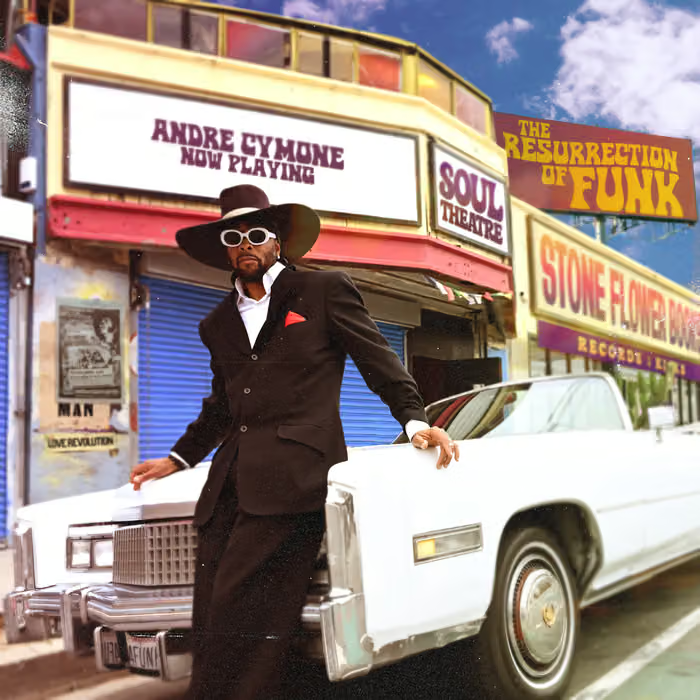
When sitting down with The Resurrection of Funk, don’t expect to be transported back to a time when funk was first hitting the scene. This is not that. This is not a return, and it is certainly not a resurrection in the sense of bringing something back from the dead. The Resurrection of Funk is the living, breathing embodiment of sound as ancestry, communion, and future—a bridge between what music has always made us feel and what music can still become.
From its opening chord, André Cymone makes it clear that the music born from Minneapolis was never meant to remain trapped in a particular era. It evolved because the people who created it evolved, and it endured because the language of funk was never confined to a moment in time. From the album cover to the final track, Cymone pulls no punches, delivering a record that doesn't ask whether funk still has a place in contemporary music. It answers the question before you ever have the chance to ask it: funk is here, it is alive, and it ain't going anywhere anytime soon.
The playful “Funk PSA” introduces Cymone as the Funk Forecaster, OG D.R.E., and our guide into the resurrection. But the welcome is only the beginning. “The Resurrection” makes the promise real, opening with a driving bass line that immediately grips the listener while Cymone's voice emerges from the groove asking, where is the funk? The question sounds almost rhetorical because the answer is already moving beneath it. Here is the funk.
The moment the album begins, closing my eyes feels less like listening to an album and more like stepping through a doorway. Suddenly, I'm in Minneapolis—at First Avenue, surrounded by the sights, sounds, and energy of a city whose musical history is impossible to separate from the people who built it.
That sense of recognition becomes even stronger with “The Girl Next Door.” There is an unmistakable familiarity in its sound that immediately calls Prince and the Minneapolis Sound to mind, including a nod to “777-9311.” But this doesn't feel like imitation. It feels like recognition—the kind that happens when you hear a musical language spoken by someone who helped create it. Moving at a slightly quicker pace, the song finds a natural meeting point between funk and R&B, further blurring the line between past and present. Rather than recreating the Minneapolis Sound, Cymone reminds us that its fingerprints are still all over the music.
The musical breakdown that closes “The Girl Next Door” clears the space beautifully for “Turn It Up.” But Cymone doesn't come barreling through the door demanding that you dance. He lures you there. The groove is so deeply embedded in the instrumentation that the body begins responding before the mind has decided to. Cymone captures movement not only sonically, but physically; the marriage of his voice and instrumentation sends vibrational cues directly to the body with one simple instruction: move.
“Turn It Up” doesn't beat you down with funk. It lullabies you into it, easing you deeper into the groove until you suddenly realize your body has answered the call. And when the track ends, almost abruptly, you're left momentarily surprised because you've been living inside that space.

The silence that follows doesn't feel like an interruption. It feels like a transfer—a layover between destinations, the brief pause before shifting gears and continuing the journey.
That shift brings us to “Love Revolution.” If “Turn It Up” is the call to action, “Love Revolution” is the action itself. Its opening call-and-response prepares us to turn it up, but Cymone gives that movement somewhere to go. His voice slides effortlessly between the rhythm section and chicken-pickin' guitar, and the song becomes a funky ode to love—playful, joyful, and completely unafraid to have fun. There is no heaviness weighing down the message; Cymone simply lets love dance.
And perhaps that is one of funk's greatest powers: resistance doesn't always need a raised fist. Sometimes it sounds like joy, feels like movement, and looks like two people deciding to love each other anyway.
That joy doesn't stay still for long. “Funk Is Alive” moves us straight back into motion, refusing to allow funk to become static. Once again, Cymone reaches into the lineage of the music with a recognizable nod to George Clinton and Parliament-Funkadelic, but the reference serves a larger purpose. He isn't simply telling us that funk is alive. He is demonstrating why it has remained necessary.
Funk has always been more than entertainment. It has given people somewhere to put their joy, frustration, confusion, and bodies. It has provided release when release was needed and connection when connection was harder to find. Listening to “Funk Is Alive,” the argument becomes difficult to dispute: we have always needed funk. Perhaps we still do.
That question lingers through “Funk Revolution PSA,” which functions as a brief intermission while keeping us firmly inside the groove. Cymone tells us funk is back and here to stay, but by this point, the declaration almost demands another question: did funk ever actually leave? Perhaps what disappeared wasn't the music itself, but our willingness to recognize what it was still doing.
The answer becomes more complicated—and more purposeful—with “The Revolution's On You in ‘O’ Net.” Cymone reaches toward the socially conscious tradition of Gil Scott-Heron, but instead of anger, fear, or rage bait, he gives us something more matter-of-fact: responsibility. Scott-Heron's influence feels less like a reference than a presence, his cadence seeming to live inside Cymone's chords. Where Scott-Heron used poetry to pull listeners into the conversation, Cymone uses funk.
And he doesn't lecture us.
He invites us.
That invitation finds its answer in “Show Me Love.” If “O” Net places responsibility in our hands, “Show Me Love” demonstrates what that responsibility might look like. Dancing between the chords, Cymone turns the song into a conversation—not a debate, not an argument, and certainly not a lecture. Love becomes something active: something we demonstrate, participate in, and move toward.

The conversation takes on a different weight with “Rockstar,” which begins with a pledge of allegiance to the culture. Sonically, Cymone merges hip-hop energy with funk, but the shift in texture is unmistakable. The music becomes heavier, slower, more grounded, and more textured, giving the vocals a weight that changes the album's energy without diminishing its movement.
More importantly, “Rockstar” makes visible something Cymone has been demonstrating throughout the album: his musical intelligence lies not simply in knowing these traditions, but in knowing how they can speak to one another. Funk, hip-hop, R&B, rock and roll, and gospel aren't presented as separate territories. He puts them in conversation with one another.
The Lord's Prayer, surrounded by those almost angelic “ahhhhhhs,” extends that conversation into something spiritual. After moving through so many sounds and histories, Cymone closes in prayer, making spirituality feel less like an addition than another natural expression of the musical language he's building.
And once again, the music refuses to stay in one place.
“Psycho Love” carries the beautiful texture of “Rockstar” forward but brightens the atmosphere, reminding us that the Minneapolis Sound Cymone helped create refuses confinement. It moves. It shifts. It changes shape.
“Hard Candy” pushes that idea even further by slowing the entire thing down, giving us what can only be described as a funky ballad. Sensual, grounded, and deeply embodied, it proves that funk doesn't require a particular tempo to remain funk. The music settles into the body rather than simply moving through it, carrying a low, rooted energy that feels almost primal.
By this point, Cymone is giving us more than a range of tempos. He's giving us a range of human experience. No person is just one thing, and by extension, neither is funk.
It can be sensual and political, playful and serious, heavy and light, spiritual and physical.
It grows.
It adapts.
It moves.
It breathes.
It becomes.
If “Hard Candy” is the seduction, “Velvet Jones” is the romance. Sensual, gentle, intimate, and undeniably funky, the song feels less like Cymone singing to a woman than Cymone singing to funk itself. In the same spirit that Rick James turned his affection for Mary Jane into music, Cymone seems to be expressing his own devotion to the sound that has carried him throughout his life.
“Velvet Jones” doesn't simply play with funk.
It sounds like Cymone is in love with it.
That love carries into “Stone in Love,” which brings back the driving bass-line energy that has propelled the album from the beginning. After spending the record moving through so many forms of funk, the song feels like the final lap through a world that has developed its own language, history, geography, and rules. I've spent the album feeling as though I've been living inside a funkaverse—one where funk isn't simply a sound, but a source of movement and a way of understanding the world.
And Cymone isn't finished.The final “Funk PSA” leaves us with a proposition: when funk rules the world, the people are free. After everything the album has demonstrated, it doesn't feel like hyperbole. It feels like the natural conclusion to the argument Cymone has been making from the beginning.
Funk doesn't need to be resurrected.
It needs to be recognized.
And just when we think the journey is complete, Cymone announces The Resurrection of Funk Part 2: A Sexy Resurrection, leaving us with the question of what the hell could possibly be coming next.
Perhaps the answer is best left to the OG D.R.E. himself:
“Life goes better with funk.”